Grand Creator
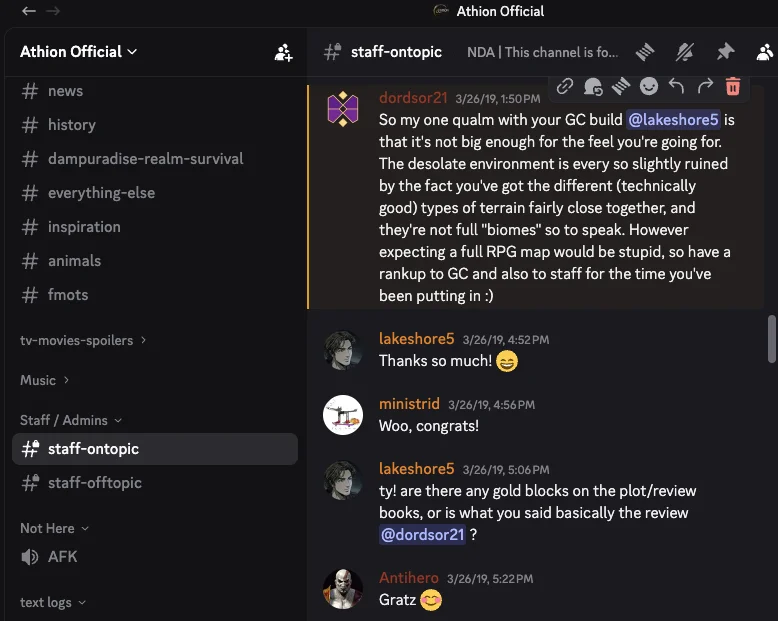
March 2019, dordsor21's summary of the Athion review of Loriostrond that led to a rank-up to Grand Creator. The feedback especially highlighted the technical challenge of the terraforming.
A solo build, a Sindarin name, and the terraforming technique that changed how a generation of Athion builders approached rock and shadow.
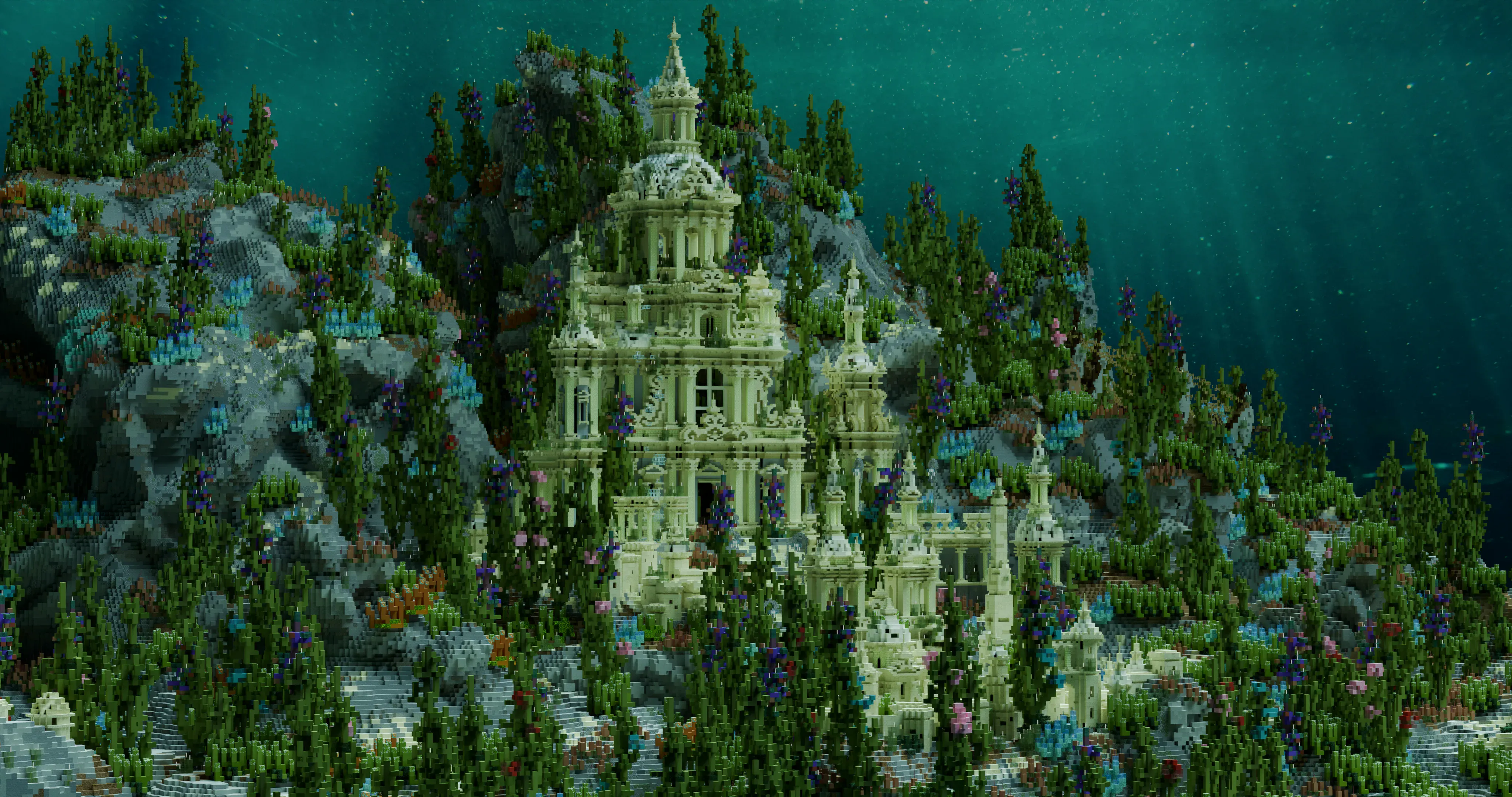
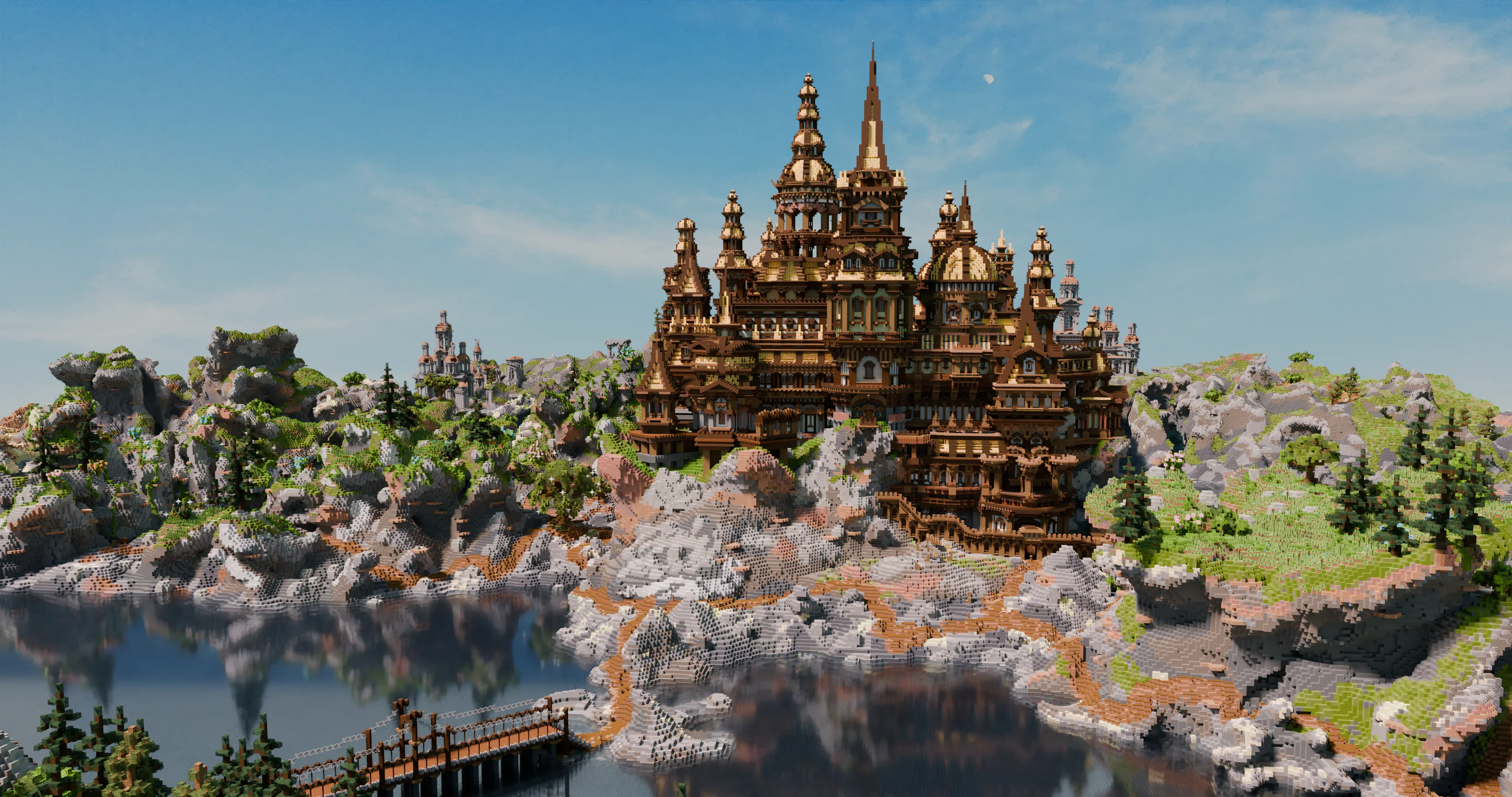
Loriostrond is the defining project of my early career. I built it entirely solo over roughly seven months, starting in 2018 and finishing in March 2019, at a scale of 1,225 × 1,225 - one contiguous Minecraft environment containing terrain, a Tolkien-inspired elven city, ruined outposts, forests, gardens, and encampments. It was the project that earned me the rank of Grand Creator on Athion Network - the fifth and final rank - and it's the project that formalised the terraforming technique I still use today.
It was also personal. Loriostrond was my idea of filling in gaps in J. R. R. Tolkien's world: a serious first-principles exploration of what the eastern reaches of Middle-earth might have looked like if the grey elves had wandered that far, and what a monument built to preserve the memory of Valinor would need to feel like.
Modern portfolios treat "professional Minecraft builder" as a job description, but a lot of the standards, tools, and workflows that make that job possible were forged in one particular corner of the game between roughly 2011 and 2019 - the era of the serious creative servers. Athion Network sits inside that lineage.
Athion launched in December 2014 from the merger of two already-established creative communities - Mithrintia (founded 2011, one of the prominent early Minecraft building collectives that later fed into groups like BlockWorks and the Hypixel Build Team) and Pwego-Insomnia / PI Creative (an ecosystem closely associated with PlotMe, one of the foundational plot-management plugins of old-school creative servers). Athion's stated goal was to build a place where players didn't just get a Creative-mode world - they could actually learn to build, formally, with review and structured progression.
In practice that meant Athion functioned almost like an art school inside Minecraft. Builders started as Students and submitted work for review, progressing through Apprentice, Designer, Creator, and finally Grand Creator. Each rank opened larger plots and increasingly powerful tools. Reviews weren't rubber-stamped - they were designed to give feedback and develop skills, and by the later years Athion had separate mastery reviews for organics, structures, and terrain. Athion also put professional building tools directly in ordinary players' hands: WorldEdit, VoxelSniper, and by 2016 a two-million-block WorldEdit limit with infrastructure tuned so massive edits wouldn't lag the server. That was almost unheard-of for a public creative server of that era.
People came out of this ecosystem and became exceptional builders. Mojang's own Minecraft site has profiled builders who described learning through Mithrintia's plot-then-feedback model, which was the direct predecessor to Athion's Training Grounds system. Athion also ran an actual commissioned build team, tracing its lineage straight back to the 2014 merger.
The easiest analogy is this: Hypixel became famous for turning Minecraft multiplayer into polished games; Athion and its predecessors were important for turning Minecraft building into a learnable craft. You joined with mediocre skills, made a plot, had stronger builders critique it, learned WorldEdit and VoxelSniper, ranked up, collaborated on megabuilds, and potentially moved into paid work. Athion's significance today is primarily historical - the server is quiet in 2026 - but its influence on modern Minecraft building is much larger than its current player count suggests. Reaching Grand Creator inside that pipeline meant your work had been reviewed and approved by peers who set the standard for the whole scene.
At the time of my rankup to Grand Creator, from 2014-2019, there had only been 2 other Athion Grand Creator Rankups, Leozy, and cakeicing. To this day, there are 5 Grand Creators total: Leozy, cakeicing, lakeshore5, creeper5777, and Alex6135, making it an incredibly rare feat.
For Loriostrond, that review was carried out by dordsor21, ToxicMugOfDeath, Bryuf, Antihero, and other Athion members. Getting a build through that group was not a formality.
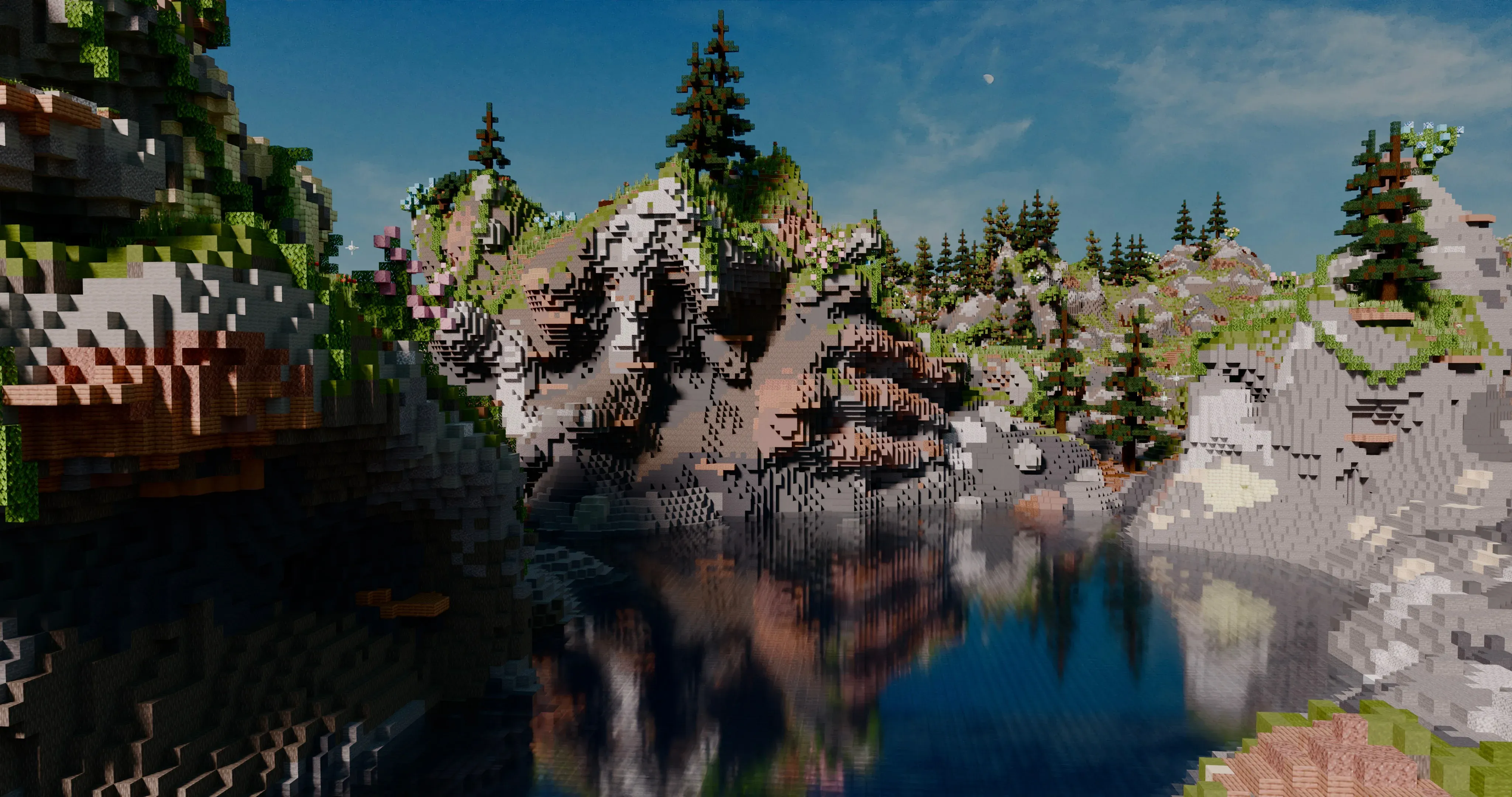
The most technically important thing about Loriostrond, and the reason it changed my own career, is the terrain.
The meta on Athion in 2018 was essentially a single gradient. Builders would pick one palette - often a mesa-style stratified gradient - and layer it across the entire build regardless of setting. Fantasy castles, sci-fi outposts, coastal cliffs, mountain fortresses - they all shared the same "pick one gradient and stack it" approach to rock. It worked as a shortcut for finishing plots quickly, but it flattened everything into the same visual language.
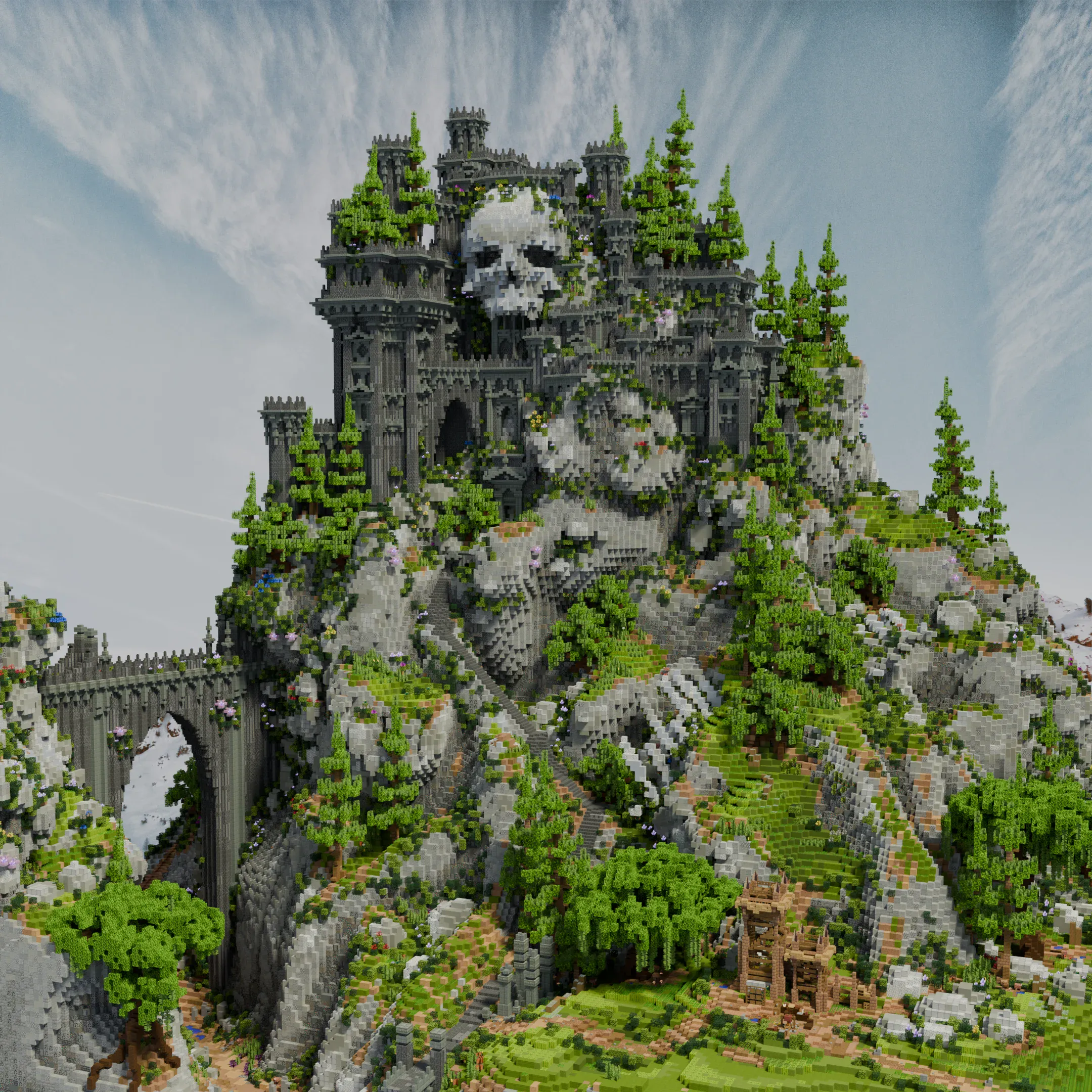
Loriostrond was the first project where I really formalised a different approach: shadow-first, formation-driven terrain. Instead of picking a gradient and stamping it uniformly, I started by studying how real rock reads - how natural shadow pools at the base of cliffs, how erosion creates value contrast along ridges, how strata angle and break under weight. Then I turned that into a technique: shape the volume first, place the deepest values inside shadow lines, layer lighter blocks along the sunlit ridges, and treat the transitions between them as intentional design decisions rather than a linear mix.
By the time Loriostrond finished, that approach had a name and a workflow, and I started teaching it to newer Athion builders. It spread quickly. Within a year it had displaced the single-gradient meta and moved out of Athion into other creative servers. That's the part of Loriostrond I'm most proud of technically - not that the terrain looks good, but that it forced a re-think of what "good terrain" meant across a whole community.
The design brief I set for myself was hard: build a city and monument that reads as a single unified place, but isn't symmetrical or predictable. A Tolkien elven stronghold is easy to imagine as a symmetrical palace; a real, lived-in citadel that's been standing for centuries isn't. I wanted the second one.
The technique I used to get there was a massing exercise before I placed a single detail. I roughed out the entire city, the palace, the ruined outposts, and the surrounding structures as VoxelSniper cubes of lapis blocks - clean, saturated blue volumes I could see at a glance from any angle. Nothing about the shapes was finalised yet; I moved them, resized them, deleted them, and re-cut them until the whole 1,225 × 1,225 read as one composition. Only then did I start replacing lapis volumes with real architecture, materials, and detail.
That approach is worth mentioning because it's easy to get lost in detail work on a build this big. The lapis-cube step meant every architectural decision was made against a composition that had already been proven to work at scale. It also meant asymmetry was a design choice, not an accident of running out of time on one side of the city.
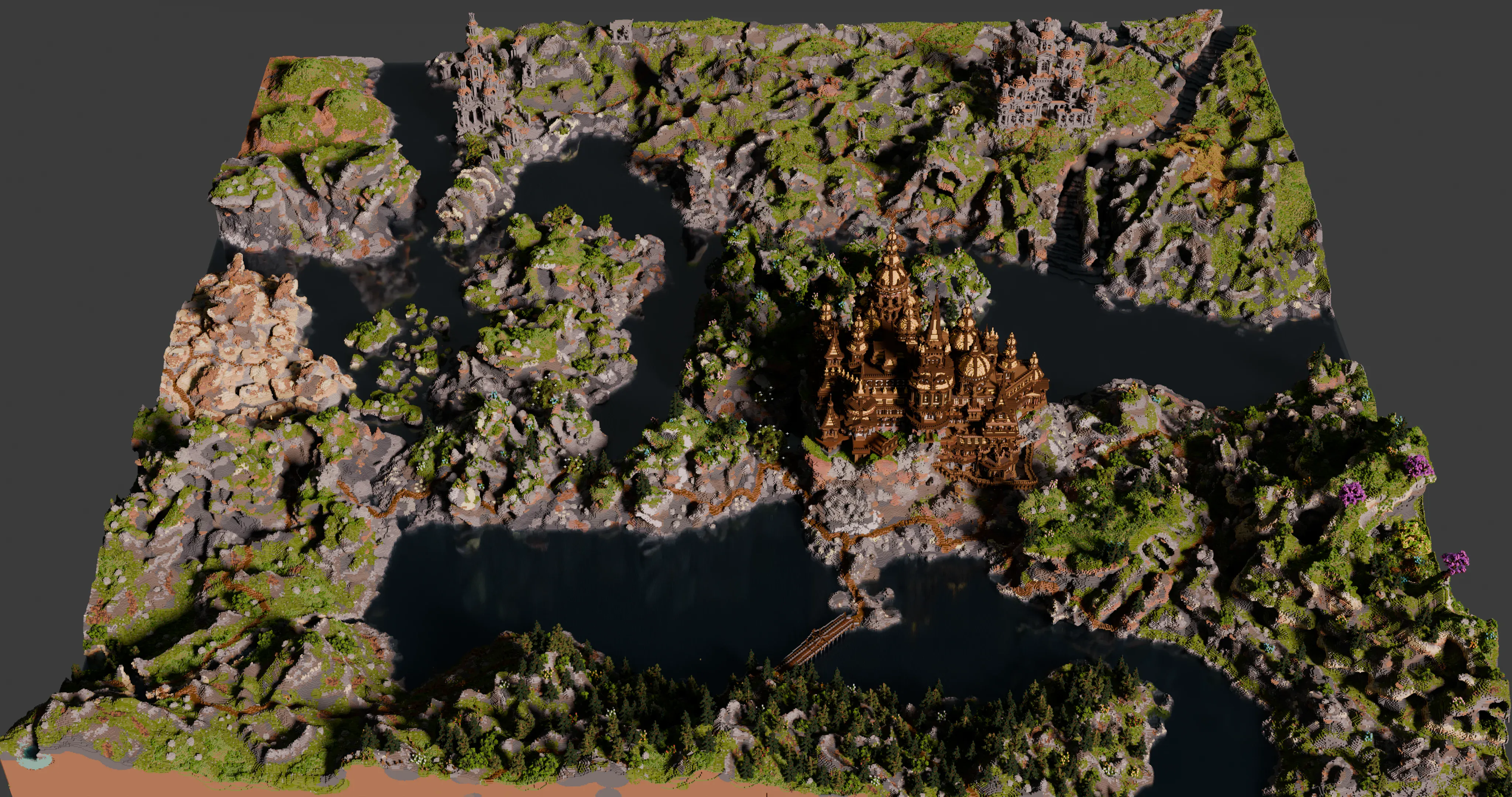
The name is Sindarin. Lori - dreams, or golden - plus ost - fortress or stronghold - plus rond - domes, or vaulted citadel. Roughly: Golden Citadel of Dreams. That name did most of the design work for me. Once it existed, I couldn't stop imagining a glittering golden city standing far from the events of the main legendarium, holding onto the near-forgotten memory of Valinor.
Loriostrond is my imagined answer to a question Tolkien never wrote about in detail: what if the grey elves reached the eastern regions of Middle-earth? The city I built is that eastern outpost - grand, ancient, and clearly past its zenith. At its heart is a garden containing two trees raised from saplings of Telperion and Laurelin, the light of the Two Trees preserved in exile. Loriostrond is a city and monument built to overlook and protect that memory.
Around the city, the world is not at peace. There are orc camps pressed against the outer walls, troll positions on the northern approaches, ruined outposts scattered across the surrounding terrain - evidence that the elves have been defending this place for a long time, and the pressure is increasing rather than easing. That tension - a glittering citadel of memory surrounded by a wearing-down world - is the emotional core of the whole build. I wanted the viewer to feel that Loriostrond had lived long enough to be tired, and that the light it protected was worth every stone.
Building an environment this size is not just "regular Minecraft building, but more of it." The failure modes are different. At 1,225 × 1,225, the biggest risk is that different regions of the build stop feeling like the same world - that the palace reads as one project, the orc camps as a second project, the terrain as a third, and the ruined outposts as a fourth. I've seen large builds fall apart that way plenty of times.
Loriostrond avoids that in three ways. First, the palette across the entire map is deliberately restrained - there's variation, but everything shares a common tonal family, so no region can look "loud" next to another. Second, the terrain was built as one continuous surface using the shadow-first technique I described above, so the rock reads as one geology whether you're at the palace steps or up in the northern trollcountry. Third, the composition was designed from the start to leave space - negative regions of terrain, forest, and ruin between the busy areas - so the eye can rest and understand where it is in the world.
Maintaining that "ancient, slightly desolate, past its zenith" feeling across so much surface area was the hardest single design problem I've solved. The build had to feel inhabited and precious in the city, empty and heavy in the ruins, and threatening at the edges - all under one palette, one geology, and one authorial hand.
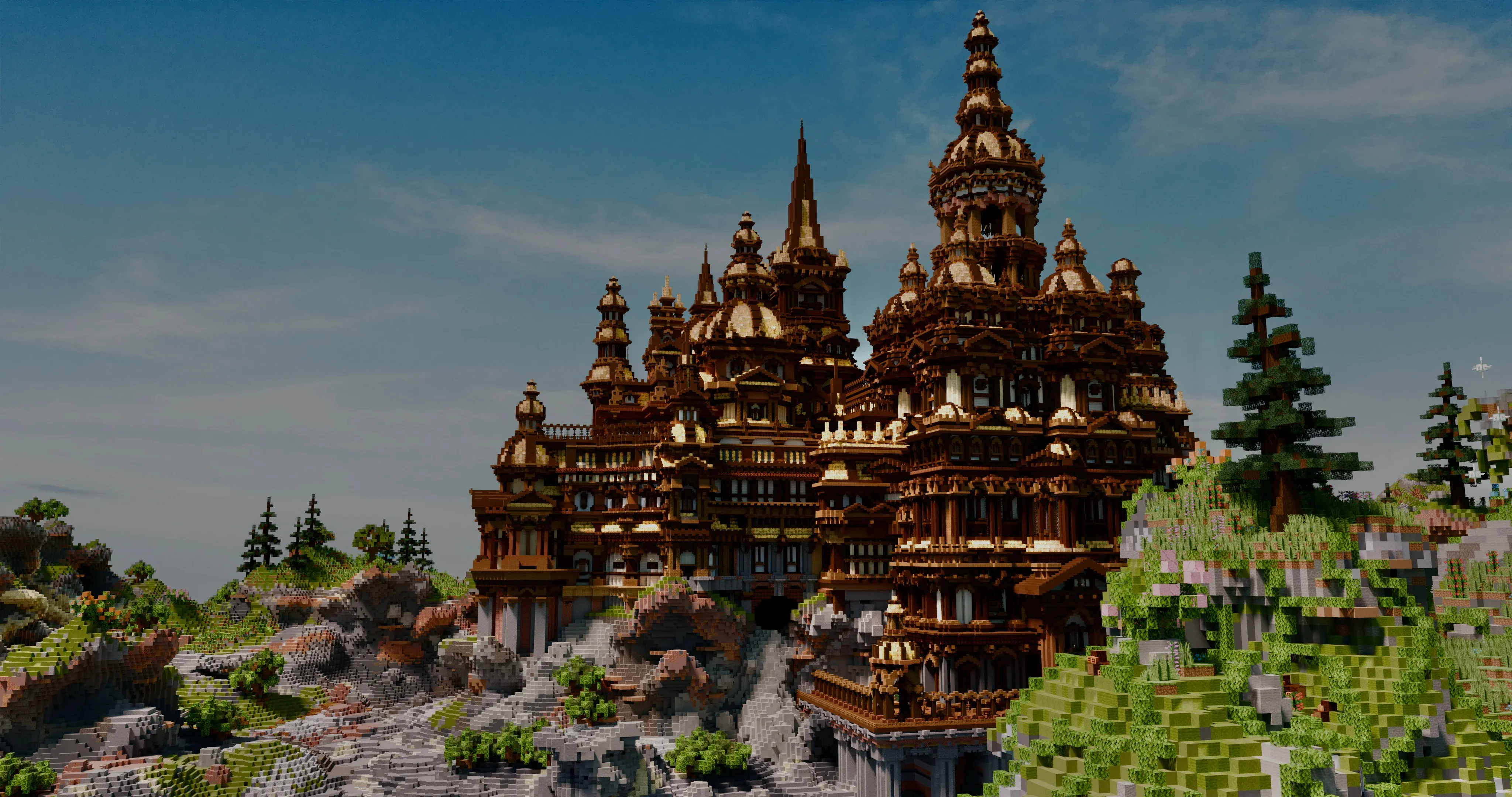
Loriostrond is the reason I now think of terrain, architecture, and composition as a single design problem instead of three separate ones. It's also the reason a specific technique for rock and shadow spread outward from Athion into the wider Minecraft creative scene. And it's the project on my portfolio I'm still most proud of, seven years later.
You can view the project page - with the full gallery and facts - here. The build is also archived on Planet Minecraft and Reddit, where it has continued to pick up views and attention.
March 2019, dordsor21's summary of the Athion review of Loriostrond that led to a rank-up to Grand Creator. The feedback especially highlighted the technical challenge of the terraforming.
1. Terrain is a design language, not a texture. Choosing a single gradient and stamping it is fast, but treating rock and shadow as intentional composition changes the emotional register of a build.
2. Massing before detail wins at scale. The lapis-cube massing pass is the reason Loriostrond reads as one place instead of four projects glued together.
3. The name matters. "Golden Citadel of Dreams" gave me a north star that no amount of individual design decisions could have supplied.
4. Peer review is not optional. Grand Creator on Athion required my work to be evaluated by builders who had already reached that standard. Getting there is the single most valuable thing that ever happened to my building.
If you're planning a Minecraft build that needs integrated terrain, architecture, and worldbuilding at scale, that's the work I do - solo, through Xenos Builds, or through C2lyn/Mythos Creations.
Discuss a Project